Data centers account for roughly 1% of global electricity consumption, and that share is climbing as artificial intelligence drives rack densities higher. Cooling IT equipment is one of the largest contributors to both electricity and water use in any facility. If your operation is under pressure to improve sustainability metrics while keeping servers online, the cooling system is where the most significant gains remain. Tranter helps data center operators address exactly that challenge.
This guide explains how Tranter plate and frame heat exchangers help data center operators reduce PUE, CUE, WUE, and ERE by addressing fouling, enabling free cooling, and making waste heat recovery more practical.
The principles covered here apply to traditional chilled-water plants, hybrid liquid-cooling architectures, and everything in between. They connect directly to your next design or retrofit decision.
Key takeaways: data center cooling with plate heat exchangers
- PUE, CUE, WUE, and ERE together give a complete picture of data center energy, carbon, water, and reuse performance.
- Cooling infrastructure is the single largest non-IT energy consumer and the primary lever for improving all four metrics.
- Plate and frame heat exchangers protect chillers from fouling, reducing electricity drift and improving PUE and CUE over time.
- Free cooling enabled by plate heat exchangers can bypass the chiller entirely when ambient conditions allow, cutting compressor energy.
- Tranter SUPERCHANGER® plate heat exchangers support waste heat recovery for district heating, greenhouses, and similar reuse applications.
Why data center cooling efficiency matters
Your servers generate heat continuously. Removing that heat consumes a significant portion of your total facility energy. That makes cooling one of the biggest variables in your sustainability performance.
Regulators, tenants, and corporate sustainability commitments increasingly require reporting beyond a single number. Four metrics now define how well your facility manages energy, carbon, water, and waste heat. Understanding what each one measures, and how your cooling system influences it, is the starting point for any improvement strategy.
Here's what each metric tells you about your operation.
What PUE, CUE, WUE, and ERE measure
PUE (Power Usage Effectiveness) compares total facility energy to IT load energy. A PUE of 1.0 would mean every watt reaches the servers with zero overhead. Lower overhead means less energy consumed by cooling and supporting infrastructure.
According to the International Energy Agency, global data center electricity consumption continues to grow, making cooling efficiency a priority for operators worldwide.
CUE (Carbon Usage Effectiveness) extends the picture to carbon emissions. Two facilities with identical PUE values can have very different CUE scores depending on their electricity source. Reducing the energy consumed by cooling lowers CUE regardless of the generation mix.
WUE (Water Usage Effectiveness) measures site water consumption relative to IT load. Traditional open cooling tower setups consume substantial volumes of water through evaporation, drift, and blowdown. Closed-loop cooling with plate heat exchangers can significantly reduce that consumption.
How ERE measures energy reuse
ERE (Energy Reuse Effectiveness) credits your facility for energy recovered and reused offsite. If your data center feeds waste heat into a district heating network, greenhouse, or aquaculture facility, that energy is subtracted from your net consumption. ERE rewards operations that treat waste heat as a resource rather than a disposal problem.
Why cooling systems carry so much sustainability weight
Cooling is the one infrastructure system that touches all four metrics simultaneously. Reducing compressor run hours lowers PUE directly. The carbon associated with that saved electricity improves CUE. Shifting from evaporative to closed-loop cooling reduces WUE. And recovering waste heat through the same cooling infrastructure drives ERE down.
No other subsystem offers that breadth of impact. That is why your choice of heat exchanger technology, and how it integrates with the rest of the cooling plant, matters more than most operators realize.
How Tranter plate heat exchangers improve data center cooling
Traditional data center cooling often relies on a chiller paired with an open cooling tower. This setup works, but it introduces fouling into the condenser circuit over time. Scale, biological growth, and particulate from the tower water gradually coat heat transfer surfaces, forcing the chiller to work harder over time.
A plate and frame heat exchanger placed between the cooling tower and the chiller changes that dynamic. It acts as an intermediate barrier, keeping tower water separate from the chiller condenser circuit while still transferring heat efficiently.
How intermediate cooling helps protect chillers
When tower water circulates directly through a chiller condenser, fouling accumulates on the condenser tubes. That fouling acts as insulation, reducing heat transfer and forcing the compressor to work harder. Over months and years, electricity consumption drifts upward even though the rated capacity hasn't changed.
Placing a plate and frame heat exchanger in the circuit gives you two separate fluid volumes. The tower-side loop handles the dirty water. The chiller-side loop stays clean.
Because the plate heat exchanger has a smaller fluid volume per circuit and higher turbulence across its surfaces, fouling accumulates more slowly. It's also easier to address during scheduled OEM service intervals.
Protecting your chiller condenser from fouling keeps its rated efficiency closer to day-one performance. That translates directly into lower electricity consumption, which reduces both PUE and CUE. The smaller circuit volume can also reduce blowdown volume, improving WUE by up to 20%.
How free cooling can reduce chiller dependence
In many climates, ambient temperatures drop low enough during cooler months that the chiller can be bypassed entirely. The plate and frame heat exchanger transfers heat from the data center cooling loop to the tower or dry cooler loop without mechanical refrigeration. This is free cooling, and it's one of the most effective ways to reduce annual cooling energy.
Plate heat exchangers are well suited to free cooling because they achieve close temperature approaches in a compact footprint. A Tranter SUPERCHANGER® gasketed plate heat exchanger can be configured for approach temperatures tight enough to extend your free-cooling window by weeks or months.
Every hour the chiller stays off is an hour of compressor energy you don't consume. Over a full year, the cumulative effect on PUE and CUE can be substantial. And because free cooling often uses closed-loop dry coolers rather than evaporative towers, WUE can improve as well.
How Tranter plate heat exchangers support waste heat recovery
Your data center rejects a large amount of thermal energy around the clock. In most facilities, that heat is simply dissipated into the atmosphere through the cooling tower or dry cooler.
Waste heat recovery turns that rejected energy into a usable resource. A study published in Applied Sciences examined how hybrid data center cooling systems can supply district heating networks effectively. The plate heat exchanger is the component that makes the transfer practical.
Why waste heat temperature matters
The usefulness of recovered heat depends on its temperature. Traditional district heating networks typically require supply temperatures between 65°C and 120°C. Data center reject heat, especially from air-cooled systems, often falls below that range.
Newer low-temperature district heating networks, sometimes called fourth-generation systems, can operate with supply temperatures as low as 20°C to 45°C. That range aligns well with the reject temperatures from liquid-cooled data centers and from plate heat exchanger intermediate loops.
Plate and frame heat exchangers recover heat efficiently even at moderate temperature differentials. Their high turbulence and counter current flow path extract more usable energy from a given stream than many alternative designs. This is where the engineering of the plate pattern directly influences how much heat you can deliver to the end user at a useful temperature.
Where recovered heat can be reused
Waste heat from data centers is already being reused in several applications. District heating is the most common, particularly in Northern Europe where low-temperature networks are expanding. Greenhouses, aquaculture facilities (fish farms), and industrial preheating processes are also viable destinations.
Every unit of energy recovered and reused offsite reduces your ERE. If your facility is located near a district heating network or an agricultural operation, waste heat recovery can turn a cost center into a sustainability advantage. It can also strengthen the business case for cooling upgrades by connecting thermal performance to a measurable downstream use.
Tranter plate and frame heat exchangers, with their compact footprint and configurable plate patterns, provide the thermal interface between your reject heat loop and the external distribution system.
Hybrid cooling architectures and emerging liquid-cooling trends
As rack densities increase, hybrid cooling architectures are becoming more common. These systems combine traditional air cooling for lower-density racks with direct liquid cooling and coolant distribution units (CDUs) for high-density AI and HPC hardware.
In a hybrid setup, plate heat exchangers serve multiple roles. They can act as the thermal interface inside liquid-to-liquid CDUs, separating IT-side coolant from facility-side water. They can also serve as the free-cooling heat exchanger in the facility plant, and as the interface to a waste heat recovery loop.
Why plate heat exchangers suit hybrid data center architectures
Hybrid architectures require heat exchangers that handle different pressure levels on each side, accommodate varying flow rates, and maintain performance across a wide operating envelope. Plate and frame heat exchangers allow different design pressures on each side of the circuit, which simplifies integration with both IT cooling loops and facility water systems.
The compact footprint is also an advantage where floor space is at a premium. Compared with shell-and-tube alternatives, plate exchangers deliver the same thermal duty in a fraction of the physical space, leaving room for additional IT equipment or infrastructure. That matters in retrofit projects where mechanical room constraints can limit what improvements are practical.
What to consider when sizing plate heat exchangers for data centers
Selecting the right plate heat exchanger for a data center application involves more than matching the duty rating. Several design parameters have an outsized effect on both initial cost and long-term performance.
Why temperature approach and pressure drop matter
Temperature approach is the difference between the outlet temperature of one fluid and the inlet temperature of the other. In data center free-cooling applications, a tighter approach means you can use ambient cooling at higher outdoor temperatures, extending the free-cooling season.
However, reducing the temperature approach increases the required heat transfer area. A change of just 0.5°C in approach can double or halve the required exchanger size. That relationship isn't linear, and it has a direct impact on capital cost and physical footprint.
Pressure drop also deserves careful attention. Higher allowable pressure drop across the plate pack increases fluid velocity, which improves heat transfer coefficients and reduces fouling tendency. In many data center applications, accepting a moderately higher pressure drop results in a smaller, more fouling-resistant exchanger that performs more consistently over its service life.
Why extra margins can work against performance
Engineers accustomed to specifying shell-and-tube heat exchangers sometimes apply the same fouling factors and safety margins to plate and frame units. This practice leads to oversized exchangers that run at lower velocities than their design intent.
Lower velocity means less turbulence across the plate surfaces. Less turbulence means more fouling. That's the opposite of the intended outcome. In plate and frame heat exchangers, the corrugated plate pattern already creates high turbulence at design flow rates. Adding extra margins on flow and duty, or applying shell-and-tube fouling factors, undermines that advantage.
The better approach is to specify based on actual duty data, accept a reasonable pressure drop, and let the plate geometry do its job. Tranter's application-driven design process sizes each exchanger to the specific operating conditions of your data center, avoiding the performance penalties that come with unnecessary oversizing.
How Tranter plate heat exchangers fit data center cooling systems
Tranter has more than 90 years of heat exchanger engineering experience, including application-specific design for data center cooling, district energy, and HVAC systems. The SUPERCHANGER® gasketed plate and frame heat exchanger is configured for each application based on actual duty data, fluid characteristics, and the specific sustainability targets your operation needs to meet.
For data center operators, that means exchangers sized to protect your chillers from fouling, extend your free-cooling operating window, and enable waste heat recovery at usable temperatures. Tranter's global service network supports every installation with OEM parts, planned maintenance, and performance optimization throughout the equipment lifecycle.
Whether you are designing a new facility, retrofitting an existing cooling plant, or integrating liquid cooling for high-density racks, the plate heat exchanger is the thermal interface that connects your cooling strategy to your sustainability goals.
In conclusion: choosing a more sustainable data center cooling strategy
Improving data center sustainability isn't a single-metric exercise. PUE, CUE, WUE, and ERE each measure a different dimension of your facility's environmental performance, and your cooling system influences all four.
Plate and frame heat exchangers give you a practical path to improvement across every metric. They protect chillers from fouling, enable free cooling, reduce water consumption, and make waste heat recovery viable. The key is to size them based on actual operating conditions, accept appropriate pressure drop, and avoid the oversizing habits that come from shell-and-tube thinking.
Your cooling infrastructure is already the largest non-IT energy consumer in the building. Making it work more efficiently, and recovering the heat it rejects, is the most direct route to a more sustainable operation. Are you considering plate heat exchangers for your data center cooling system? Contact us for more information.
FAQs about data center cooling with plate heat exchangers
What is PUE and why does it matter for data centers?
PUE (Power Usage Effectiveness) measures total facility energy divided by IT load energy. A lower PUE means more of your electricity reaches the servers and less is consumed by cooling, lighting, and other overhead. Reducing cooling energy is the most effective way to improve PUE in most facilities.
How do plate heat exchangers reduce data center water usage?
Plate and frame heat exchangers reduce WUE by separating the cooling tower circuit from the chiller condenser loop. This smaller, cleaner circuit requires less chemical treatment and produces less blowdown. In some configurations, the reduction in site water consumption can reach 20%.
Can data center waste heat be used for district heating?
Yes. Newer low-temperature district heating networks operate at supply temperatures between 20°C and 45°C, which aligns with typical data center reject temperatures. A Tranter plate and frame heat exchanger provides the thermal interface between your reject heat loop and the district heating distribution system, improving your ERE in the process.
What is free cooling and how does it work in a data center?
Free cooling bypasses the chiller when ambient temperatures are low enough to reject data center heat directly through a dry cooler or cooling tower. The plate heat exchanger transfers heat between the facility cooling loop and the ambient rejection loop without compressor energy. Tranter SUPERCHANGER® exchangers achieve tight approach temperatures that extend the free-cooling season.
Why should you avoid applying shell-and-tube fouling factors to plate heat exchangers?
Shell-and-tube fouling factors assume lower fluid velocities and less turbulence than plate heat exchangers produce. Applying them leads to oversized units that run at reduced velocity, which actually increases fouling. Tranter's application-driven sizing process uses duty data specific to your operating conditions, avoiding the performance penalties of unnecessary margins.
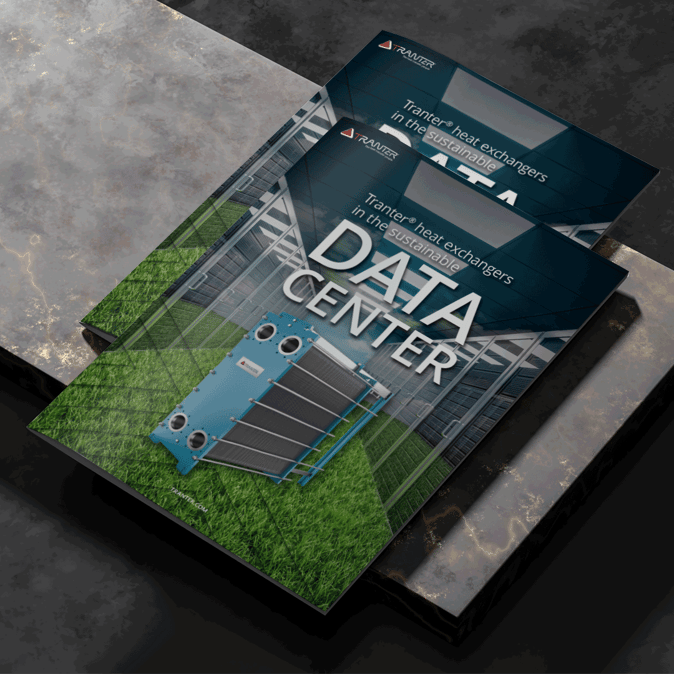
If you want to review these configurations in a more practical format, our four-page data center leaflet maps the intermediate cooling, free-cooling, and waste heat recovery loops as system schematics your team can use.