Interactive model

Heat transfer in FPSO

FPSO:s (Floating Production, Storage and Offloading) rely on efficient heat transfer across a wide range of process duties. Explore how Tranter solutions support key applications throughout the FPSO, helping to optimize energy use, reliability and footprint in demanding offshore environments.

Inside the application

Tranter solutions for FPSO applications

Produced water cooler

The feedwater to the desalter is heated by exchanging heat with produced water from the desalter. Tranter gasketed plate and frame heat exchangers generate high wall shear stress, helping to reduce the risk of fouling on the produced water side.
Shell and plate interstage cooler I

Hydrocarbon gas separated from the production fluids in the production separator need to be compressed and condensed to reduce emissions and recover valuable hydrocarbons. The hot hydrocarbon gas leaving the compressor is cooled in the shell and plate interstage coolers and condensed liquids are separated from the gas stream in the flash drums. Using a Shell and plate unit over a Shell and tube or Printed Circuit unit, saves CAPX and space, and it minimizes fouling, OPEX and the utility consumption.

Shell and plate interstage cooler II

Hydrocarbon gas separated from the production fluids in the production separator need to be compressed and condensed to reduce emissions and recover valuable hydrocarbons. The hot hydrocarbon gas leaving the compressor is cooled in the shell and plate interstage coolers and condensed liquids are separated from the gas stream in the flash drums. Using a Shell and plate unit over a Shell and tube or Printed Circuit unit, saves CAPX and space, and it minimizes fouling, OPEX and the utility consumption.

Crude oil interchanger

Dry crude oil coming from the desalter is interchanged with untreated crude oil from the multiphase separator, thus reducing the heat input required to the crude oil inlet heater. Tranter Gasketed plate and frame heat exchangers, normally in 2 x 100% or 3 x 50% configurations for easy maintenance, provides a compact design that is easy to install on modules. Plate technology minimizes fouling through high channel velocities and shear stress, while its high thermal efficiency improves heat recovery, reducing heating medium consumption and CO₂ emissions.

Crude oil heaters

Wet crude oil is heated to the final desalting temperature using hot water or steam. Tranter’s energy process line gasketed plate and frame heat exchangers are specifically designed to prevent plate flexing while delivering high thermal efficiency, reducing the overall energy required to reach the crude desalting temperature. Where high-pressure steam is used as the heating medium, gasket-free solutions such as Tranter Shell and plate heat exchangers or Welded Block units can complement conventional gasketed installations.

Process cooling medium cooler I

Process cooling medium coolers use seawater to cool the fresh water or glycol-based cooling medium used throughout FPSO process systems. Tranter’s energy process line gasketed plate and frame heat exchangers are designed to handle large flow rates in a compact footprint. Their high heat transfer coefficients enable precise temperature control while maximizing the effectiveness of the cooling medium. High turbulence and wall shear stress help reduce fouling, while 2 × 100% or 3 × 50% configurations simplify maintenance and support high operational availability.

Process cooling medium cooler II

Process cooling medium coolers use seawater to cool the fresh water or glycol-based cooling medium used throughout FPSO process systems. Tranter’s energy process line gasketed plate and frame heat exchangers are designed to handle large flow rates in a compact footprint. Their high heat transfer coefficients enable precise temperature control while maximizing the effectiveness of the cooling medium. High turbulence and wall shear stress help reduce fouling, while 2 × 100% or 3 × 50% configurations simplify maintenance and support high operational availability.

Lean amine trim cooler

Before entering the absorber, the lean amine needs to be cooled to the required absorption temperature. A Tranter ThermoFit gasketed plate and frame heat exchanger as trim cooler is easily maintained and provides precise temperature control.

Acid gas condenser

At the top of the stripper column, condensable vapors are partially condensed using a Tranter shell and plate heat exchanger. The remaining non-condensable acid gases, primarily H₂S and CO₂, leave the top of the column for further treatment. As an acid gas condenser, the Tranter shell and plate heat exchanger provides a compact, gasket-free design and can operate with low gas-side pressure drop due to the short flow paths created by its circular plate design.

Stripper reboiler

Acidic components are evaporated in the reboiler section of the stripper system. The short flow paths and high thermal efficiency of the Tranter shell and plate heat exchanger make it well suited for reboiler duties, while providing significant space and weight savings compared to traditional shell and tube heat exchangers.

Lean/rich amine interchanger

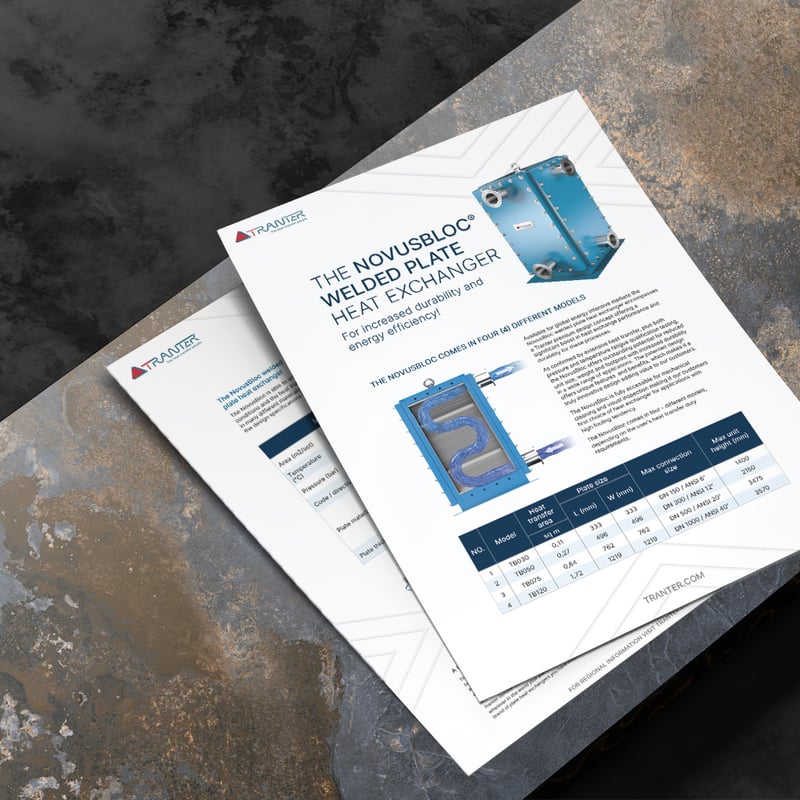
The rich amine containing acidic components is heated by lean amine from the regenerator. Tranter NovusBloc welded block heat exchangers provide a gasket-free design with increased tolerance to process conditions such as elevated temperatures, high H₂S concentrations, and dissolved heavy hydrocarbons in the amine, while maintaining easy access to both sides for inspection and cleaning. NovusBloc can achieve high heat recovery, improving the efficiency of FPSO processing systems with a compact footprint. Where process conditions permit, Tranter Energy Process Line gasketed plate and frame heat exchangers can be a flexible alternative.

Lean TEG cooler

Lean TEG is cooled to the optimum temperature before entering the absorber. For maximum absorption efficiency, the pump can be installed upstream of the TEG cooler, making the Tranter shell and plate heat exchanger an optimal choice. Its compact design can handle high pressures while reducing space and weight requirements on the gas dehydration skid compared to traditional shell and tube heat exchangers. When the pump is installed downstream of the cooler, a Tranter gasketed plate and frame heat exchanger can be used, providing easy maintenance.

Vent condenser

A Tranter shell and plate heat exchanger can be used at the top of the stripping column to condense the water and hydrocarbon mixture. The shell and plate heat exchanger provides a compact, low-weight, gasket-free design.

Lean/rich TEG interchanger

The rich triethylene glycol (TEG) is preheated before entering the stripper using a Tranter NovusBloc welded block heat exchanger or shell and plate heat exchanger. The heat exchanger minimizes the required reboiler duty while meeting the low-pressure-drop requirements on the lean side. Both designs provide a gasket-free solution with significantly lower space and weight requirements than traditional shell and tube heat exchangers. NovusBloc and shell and plate heat exchangers can achieve a closer practical temperature approach, reducing the energy required by the FPSO process system.

Shell and plate interstage cooler I

Gas is compressed in multiple stages and cooled in interstage coolers. Condensed liquids are separated from the gas stream in flash drums after each cooling stage, continuously removing liquids before the gas enters the next compression stage. Depending on the required gas dryness, dehydration may be required prior to the final discharge compression stage. Tranter shell and plate heat exchangers used as interstage coolers provide excellent reliability due to their high resistance to pressure and thermal fatigue. Their short flow paths and large flow cross-sections also make them particularly suited for two-phase flows with a high LMTD between the hot and cold sides of the heat exchanger.

Shell and plate interstage cooler II

Gas is compressed in multiple stages and cooled in interstage coolers. Condensed liquids are separated from the gas stream in flash drums after each cooling stage, continuously removing liquids before the gas enters the next compression stage. Depending on the required gas dryness, dehydration may be required prior to the final discharge compression stage. Tranter shell and plate heat exchangers used as interstage coolers provide excellent reliability due to their high resistance to pressure and thermal fatigue. Their short flow paths and large flow cross-sections also make them particularly suited for two-phase flows with a high LMTD between the hot and cold sides of the heat exchanger.

Shell and plate interstage cooler III

Gas is compressed in multiple stages and cooled in interstage coolers. Condensed liquids are separated from the gas stream in flash drums after each cooling stage, continuously removing liquids before the gas enters the next compression stage. Depending on the required gas dryness, dehydration may be required prior to the final discharge compression stage. Tranter shell and plate heat exchangers used as interstage coolers provide excellent reliability due to their high resistance to pressure and thermal fatigue. Their short flow paths and large flow cross-sections also make them particularly suited for two-phase flows with a high LMTD between the hot and cold sides of the heat exchanger.

Camshaft lube oil cooler

The Camshaft Lube oil cooler cools removes heat from the lube oil circulating the camshaft bearings. Tranter's marine gasketed plate and frame heat exchangers provides reliable operation and precise temperature control, ensuring the right oil viscosity for effective lubrication of the camshaft mechanism and preventing thermal shock. 

Main engine lube oil cooler

The hot lube oil is cooled in a Tranter marine gasketed plate and frame heat exchanger using the low-temperature (LT) central cooling freshwater. Without proper cooling, the lubricating oil can degrade, leading to reduced efficiency and failure of critical engine components. Tranter marine gasketed plate and frame heat exchangers provide precise temperature control, reliable operation at sea and easy maintenance. Tranter's global marine service offers emergency service or service contracts in most ports around the world.

ME/TC lube oil cooler

The Main Engine Turbocharger (ME/TC) Lube oil cooler is a specialized heat exchanger in a marine diesel engine designed to reduce the temperature of the lube oil used for the turbocharger bearings. The cooler removes the immense heat absorbed by the oil as it passes through the high-speed, high-temperature turbocharger bearings, typically using freshwater from the engine's low-temperature cooling system. Tranter's marine gasketed plate and frame heat exchanger provides reliable operation to maintain lube oil viscosity and prevent oil breakdown that will cause bearing failure.

Stern tube lube oil cooler

While many ships rely on natural cooling through the shell plating, a dedicated lube oil cooler may be required when the heat generated by friction exceeds the stern tube’s natural heat dissipation capacity to the surrounding seawater. This is particularly relevant for vessels with high-power engines or when using specialized lubricants. Tranter Marine gasketed plate and frame heat exchangers provide continuous temperature control, maintaining proper oil viscosity and temperature to help extend seal life while reducing the risk of water contamination and oil degradation.

Jacket water cooler

The jacket water cooler cools the closed-loop fresh water that removes heat from the engine's highest-temperature areas (jackets) such as engine cylinder liners and exhaust valves. Heated jacket water flows from the engine to the Tranter marine gasketed plate and frame heat exchanger, where it exchanges heat to the cooling medium before being pumped back into the engine, protecting the engine from over-heating.

MGO cooler

The MGO cooler reduces the temperature of marine gas oil (MGO) to increase its viscosity for safe engine operation. Low-viscosity MGO can lead to excessive wear and fuel pump damage, making temperature control essential for reliable operation and long equipment life. Tranter marine gasketed plate and frame heat exchangers provide reliable performance and precise temperature control.

Central fresh water coolers

Central fresh water coolers use seawater to cool a secondary fresh water circuit. This circuit supplies a range of coolers, including lube oil coolers, jacket water coolers and charge air coolers. Using fresh water in the secondary circuit helps minimize corrosion and scaling in machinery and equipment, supporting reliable operation. Tranter Marine gasketed plate and frame heat exchangers equipped with titanium plates provide excellent corrosion resistance in seawater service, along with high thermal efficiency and precise temperature control. The high turbulence generated within the plate channels helps reduce scaling and biological growth. Tranter central fresh water coolers comes equipped with in-line strainers on the seawater inlet to capture debris and particles, supporting efficient long-term operation.